
APPLICATION DOMAIN
Smart Home & Security Access
Smart locks, robot vacuums, door/window anti-theft, range hood/curtain limit sensing
Scope
Smart lock latch-state detection, smart robot vacuum collision/water-tank positioning, smart door/window anti-theft sensing, smart range hood/dishwasher door limits, smart toilet sprayer stroke, smart curtain motor limits, smart home appliances, washing machines, electric curtains, coffee machines, refrigerators, air conditioners, heaters, treadmills, monitoring equipment
Ouzhuo Solution
Select by parameter →| Model | Type | Temperature | Voltage | Package |
|---|---|---|---|---|
| OH3144 | Unipolar Hall IC | -40~125℃ | 4~24V | TO-92S |
| OH3020 | Unipolar Hall IC | -40~125℃ | 4.5~24V | TO-92S |
| OH9213 | Omnipolar & Micropower Hall IC | -40~125℃ | 1.65-6V | SOT23 / DFN2*2-3 / T-SOT-23-3 |
| OH9245-S | Omnipolar & Micropower Hall IC | -40~150℃ | 2.8~24V | SOT23-3 |
| OH9253-S | Omnipolar & Micropower Hall IC | -40~85℃ | 2.5~6V | SOT23-3 |
| OH4913 | Omnipolar & Micropower Hall IC | -20~85℃ | 2.4-6V | TO-92S |
| OH41OH41A | Bipolar & Latch Hall IC | -40~150℃ | 4.5~ 24V | TO-92S |
| OH137A0OH17 | Bipolar & Latch Hall IC | -20~85℃ | 4.5~ 24V | SOT23 / TO-92S |
| OH920 | Bipolar & Latch Hall IC | -40~150℃ | 3.5~ 20V | SOT23 |
Application Focus
Appliance Control Panel & Textile MachineryPosition and speed detection in appliance control panels, sewing equipment and textile machinery.
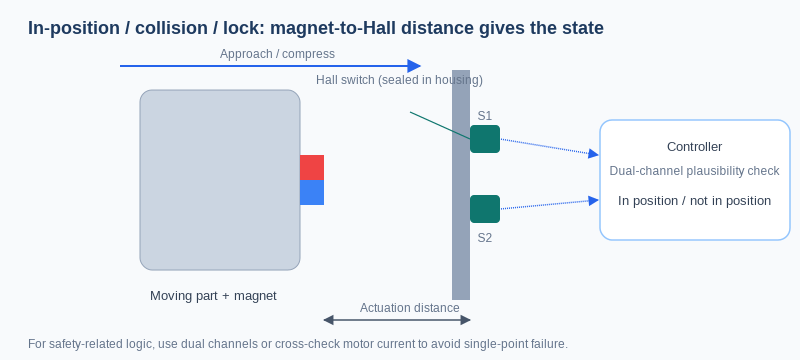
Position detection on appliance control panels often covers knob detents, door/lid opening and drawer seating. A magnet is embedded in the knob and Hall sensors are placed at each detent on the PCB, so the output changes at the corresponding position; doors and drawers use one magnet with one Hall sensor for open/close detection. Sewing and textile machinery also use gear teeth or a magnetic ring to measure spindle speed and multi-axis synchronisation, with pulse frequency corresponding to speed.
- Applicable types
- Unipolar switch, Gear-tooth sensor
- Operating temperature
- -20~85°C
- Supply voltage
- 5 V
- Output
- Digital switch
- AEC-Q100
- Not required
- Operating environment
- Indoor ambient temperature with vibration and possible dust; not automotive grade and no waterproof requirement.
- Confirm before selection
- Position or speed detection; mounting air gap; magnet type; operating temperature range; switch or analog output.
Key points
- Detent spacing and sensing zone. When detents are close, one magnet may trigger two adjacent Hall sensors; use a smaller magnet or increase spacing.
- Coaxiality and air gap. The knob must be coaxial with the PCB, and the gear ring or magnetic ring on textile machinery needs an even air gap around the full circle.
- Environmental protection. Appliances need moisture and oil protection, while textile equipment needs protection from lint and oil mist; the sensing face should be easy to clean.
Recommended models
FAQ
- Knob position is misread — what should I check first?
- Check magnet-to-Hall alignment, whether detent spacing is narrower than the sensing zone, and whether the panel is deformed.
- Textile machine speed counting misses pulses — how should I troubleshoot?
- Check air gap, tooth form and lint wrapping, and confirm pulses are still distinguishable at maximum speed.
- The door state is opposite to reality — what should I do?
- Check magnet polarity, output logic and controller configuration, and confirm parameters match after replacing the panel.
- False operation after lint or oil accumulates — what should I do?
- Clean the sensing face, check the protection structure, and confirm no ferrous foreign matter is near the magnet.
- Speed display jumps at low speed — what should I do?
- Adjust debounce time and sampling window, and check whether pulse amplitude is sufficient at minimum speed.
Coffee Machine Water Level & Grounds DetectionMinimum water level and maximum coffee-grounds detection for coffee machines.
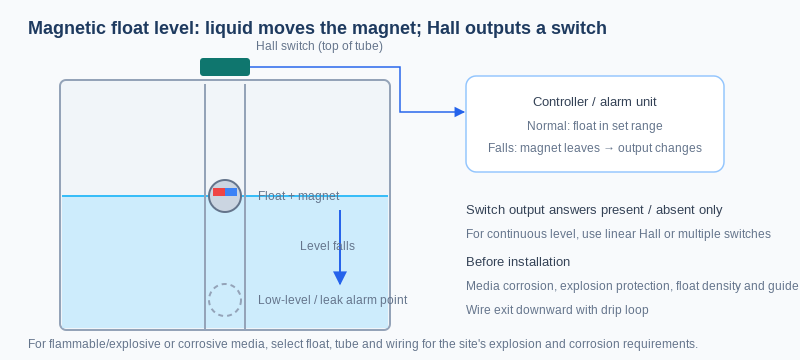
Coffee machine water-level detection often places a magnet-equipped float inside the tank with the Hall sensor on the outside wall, so it never touches the water. As the level changes, the float rises and falls and the field at the Hall sensor changes; a state change indicates the set level. The "grounds container full" check uses the same idea: a magnet on the container or drawer moving part and a fixed Hall sensor in the body give a state when pushed in or pulled out.
- Applicable types
- Omnipolar switch, Unipolar switch
- Operating temperature
- -20~85°C
- Supply voltage
- 5 V
- Output
- Digital switch
- AEC-Q100
- Not required
- Operating environment
- Inside an appliance at ambient temperature with damp steam, possible pump/motor vibration; not automotive grade.
- Confirm before selection
- Whether a water-level float magnet or grounds-bin magnet is detected; mounting air gap and magnet size/strength; omnipolar (both poles trigger) or unipolar; supply voltage and output load (direct MCU or relay).
Key points
- Float guide freedom. The float must move freely up and down; too tight a guide clearance causes sticking, while too loose lets the float tilt off the Hall axis.
- Distance fixed by the structure. The horizontal distance between Hall sensor and float must be fixed; wall thickness and mounting-hole position change the actual sensing distance.
- Wash resistance and low power. The magnet must resist moisture, rust and delamination, and the Hall sensor needs potting; low-power models must also account for sleep current.
Recommended models
FAQ
- The low-water alarm comes and goes — what should I check first?
- Check whether the float is stuck by scale or coffee powder, and whether the tank is fully seated, shifting the magnet off the Hall sensor.
- Detection fails after cleaning or descaling — what causes it?
- Check whether the float is stuck by cleaning agent, whether the magnet has delaminated, and whether residue on the tank wall has changed the sensing distance.
- The grounds bin is full but no alarm — what should I do?
- Check whether the magnet has detached, whether the bin is fully pushed in, and whether the Hall sensor is outside the sensing zone.
- It reports low water immediately after filling — how should I troubleshoot?
- This may be float density or guide structure, or a mismatch between Hall polarity and program configuration.
- Power consumption is high after long use — what should I do?
- Check sleep and sampling duty-cycle settings and avoid leaving the Hall sensor active for long periods.
Dishwasher Door & Lock DetectionDoor-closed, lock and safety interlock detection for dishwashers and washing machines.
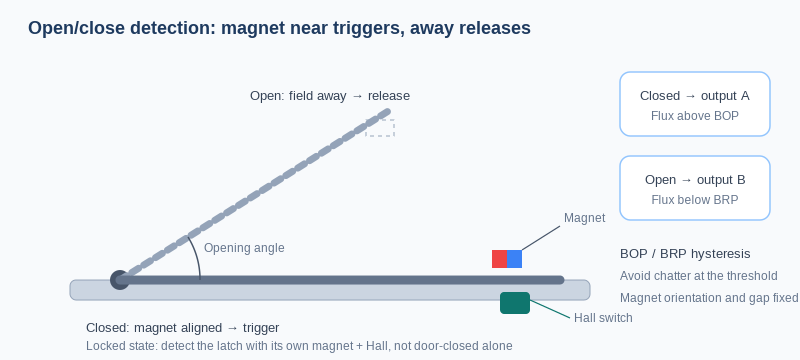
A dishwasher or washing machine must confirm that the door is closed and locked before filling, heating or high-speed spinning. A common design fixes a magnet to the door edge and a Hall sensor at the corresponding position in the body; when the door closes the magnet approaches and the output indicates closed. An omnipolar switch is insensitive to magnet orientation and suits appliance structures with larger door gaps and assembly tolerance; a unipolar switch gives a more definite operating point when needed.
- Applicable types
- Omnipolar switch, Unipolar switch
- Operating temperature
- -20~85°C
- Supply voltage
- 5 V
- Output
- Digital switch
- AEC-Q100
- Not required
- Operating environment
- High temperature and humidity, steam, detergent corrosion and vibration; frequent door opening and closing.
- Confirm before selection
- Door motion path and magnet position; maximum temperature and steam environment; controller input level; whether both door-closed and locked feedback are needed; potting and waterproof requirements.
Key points
- Keep closed and locked separate. The door Hall sensor only confirms the door is closed; locking needs a door-lock switch or a second signal. A single Hall sensor is not sufficient permission to run.
- Steam and damp heat. Keep the Hall sensor out of direct steam, and use a package that tolerates long-term heat and humidity inside a dishwasher.
- Cycle life and bracket. Vibration and impact from frequent door cycles require reliable anti-loosening for the magnet bracket and solder joints.
Recommended models
FAQ
- The door is closed but the appliance says it is open — what should I check first?
- Check whether the door seal has aged or the hinge has sagged, increasing the magnet-to-Hall distance.
- False operation in a steam environment — what causes it?
- High temperature changes magnet flux and the Hall threshold; check device temperature rating and mounting position.
- Lock state and closed state are not synchronized — what should I do?
- The two signals come from different mechanisms; confirm whether the lock is really engaged rather than looking only at door position.
- Failure after detergent or moisture enters — how should I troubleshoot?
- Check potting, seals and the pin root; condensation causes leakage.
- It loosens after frequent cycles — what should I do?
- A loose magnet bracket or Hall fixing changes the air gap; add anti-loosening and perform endurance validation.
Dishwasher Door, Water Level & Spray ArmDoor-closed, wash-water level and spray-arm speed detection for dishwashers.
Dishwasher detection points include door lock, wash-water level and spray-arm speed. Door detection embeds a magnet in the door hook or lock mechanism with the Hall sensor inside the door frame. Level detection uses a magnet-equipped float with a Hall sensor; the float rises and falls with the water and the sensor outside the tub determines high or low level. Spray-arm speed uses a magnet on the arm or rotating hub, with the Hall sensor receiving one pulse per revolution to determine whether the arm is blocked by dishes.
- Applicable types
- Omnipolar switch, Unipolar switch, Gear-tooth sensor
- Operating temperature
- -20~85°C
- Supply voltage
- 5 V / 3.3 V
- Output
- Digital switch
- AEC-Q100
- Not required
- Operating environment
- Inside an appliance with high humidity, steam and detergent contamination; pump and spray-arm vibration; 5 V/3.3 V control-board supply.
- Confirm before selection
- Whether door-closed, water-level float or spray-arm speed is detected; air gap and magnet size/strength; omnipolar (both poles) or unipolar; switch or frequency output and load; protection and temperature requirements.
Key points
- Three detection points, three tolerances. Door lock, float and spray-arm magnets must all face their Hall sensors after actuation; door-seal compression and door sag change the lock air gap.
- Float and spray-arm motion stability. The float guide must not stick on scale or food residue, and the spray-arm magnet must keep its axial and radial position while rotating.
- High heat, humidity and corrosion. Pot or conformal-coat the Hall sensor and solder joints, protect connectors from moisture, and check material compatibility against detergent corrosion.
Recommended models
FAQ
- The door is closed but reports unlocked — what should I check first?
- Check the door-hook magnet, door-seal compression and door sag, and confirm the Hall sensor mounting position has not shifted.
- The water-level alarm comes and goes — what causes it?
- Check whether the float is stuck by scale or residue and whether water movement makes it oscillate at the operating point.
- The spray arm is blocked but no alarm — what should I do?
- Check whether the arm magnet has detached, whether pulses are filtered out by debounce, and whether dishes are blocking the arm.
- Detection fails after long use — how should I troubleshoot?
- Check scale and grease buildup, connector moisture, and the integrity of potting and sealing.
- State is reversed after replacing the door lock or float — what should I do?
- Check magnet polarity and output-logic configuration, and confirm the new part matches the original design.
Dryer Door & Drum DetectionDoor-closed, drum speed and drum position detection for dryers.
A dryer mainly needs two detection points: whether the door is closed and whether the drum is turning and at what speed. Door detection usually embeds a magnet in the door hook or lid edge with the Hall sensor inside the door frame; when the door closes the output changes. Drum detection mounts a magnet or magnetic ring on the drum pulley, rear shaft or motor shaft with the Hall sensor fixed to the frame, producing a fixed number of pulses per revolution. A bipolar latch can also determine rotation direction.
- Applicable types
- Omnipolar switch, Unipolar switch, Bipolar latch
- Operating temperature
- -20~85°C
- Supply voltage
- 5 V / 3.3 V
- Output
- Digital switch, Digital latch
- AEC-Q100
- Not required
- Operating environment
- Inside an appliance with high heat and humidity, drum vibration, possible steam and lint; 5 V/3.3 V control-board supply.
- Confirm before selection
- Whether door-closed or drum speed/position is detected; if speed, tooth count/pole pairs, air gap and magnet strength; square-wave frequency or latch switch output; maximum temperature and protection requirements.
Key points
- Air gap after latch engagement. Door magnet and Hall sensor must stay stable after the hook fully engages; hook wear, seal compression and door sag change the air gap.
- Drum consistency around the full turn. The drum magnet must keep a consistent air gap around the whole revolution; pulley runout and bearing wear show up directly in pulse spacing.
- Heat and lint. The Hall sensor and solder joints must tolerate long-term heat, and the sensing face and cooling openings should be easy to clean or protected from lint.
Recommended models
FAQ
- The door is closed but still reports open — what should I check first?
- Check whether the door-hook magnet is loose, whether the door seal has increased the air gap, and whether the hook is worn.
- The drum turns but the display says it is not — what causes it?
- Check whether the magnet has detached, whether lint covers the sensing face, and whether the Hall signal wire is worn through.
- Speed display fluctuates periodically — how should I troubleshoot?
- Check pulley runout, bearing wear and magnet mounting; air-gap changes appear directly in pulse spacing.
- Abnormal operation after a period at high temperature — what should I do?
- Check Hall and solder-joint temperature rating, and whether harness insulation has aged from heat.
- State is wrong after replacing the door lock or drum — what should I do?
- Check magnet polarity, pulse count and controller configuration, and confirm the new part matches the original design.
Oven, Hob & Range Hood DetectionOven door, hob/induction knob, damper and range-hood fan speed detection.
Hall detection in ovens and range hoods falls into three groups: door-closed, knob or damper position, and fan speed. Door detection embeds a magnet in the door edge with the Hall sensor inside the body; closing the door brings the magnet near and changes the output. Knobs and dampers can use several magnets around a circle or a sector magnet with an omnipolar/unipolar switch to read the position. Fan speed uses a magnetic ring on the impeller or motor shaft, with Hall pulses feeding the controller for speed calculation.
- Applicable types
- Omnipolar switch, Unipolar switch, Gear-tooth sensor
- Operating temperature
- -20~85°C
- Supply voltage
- 5 V / 3.3 V
- Output
- Digital switch
- AEC-Q100
- Not required
- Operating environment
- Kitchen environment with grease, elevated ambient temperature and vibration from the hood fan; not automotive grade and not waterproof.
- Confirm before selection
- Whether oven-door closed, hob/induction knob position, damper position or hood fan speed is detected; air gap and magnet strength; omnipolar or unipolar; switch or frequency output; grease and temperature requirements.
Key points
- Distance from heat and grease. Door, knob and fan sensors must avoid direct heat and grease accumulation; plastic brackets inside an oven should use heat-rated material or move into a cooler zone.
- Door tolerance and air gap. Calculate the door magnet-to-Hall air gap from door tolerance, and the magnet must not interfere with the door seal or hinge movement.
- Magnet temperature and interference. Check the maximum operating temperature and magnet flux loss at high temperature; grease, iron filings and nearby motors also change the field distribution.
Recommended models
FAQ
- Door state is misjudged after the oven gets hot — what causes it?
- This is usually magnet demagnetization, bracket deformation or an increased air gap; calculate flux at the worst-case temperature.
- It gradually fails as grease accumulates — what should I do?
- Grease increases the effective air gap and iron filings change the magnetic path; improve mounting protection and clean the sensing face.
- Fan speed reads inaccurately or misses pulses — what should I check first?
- Check ring air gap, impeller balance and bearing condition, then whether controller filtering suits high speed.
- Knob position jumps — how should I troubleshoot?
- Check magnet position and alignment with the operating point, and whether adjacent positions interfere; add a confirmation delay in software.
- False triggering in standby or off state — what could cause it?
- Interference from nearby motors, transformers and relays, or signal wires running parallel to power wiring; add filtering and shielding.
Washing Machine Speed & PositionMotor or drum speed and position detection for washing-machine control and balancing.
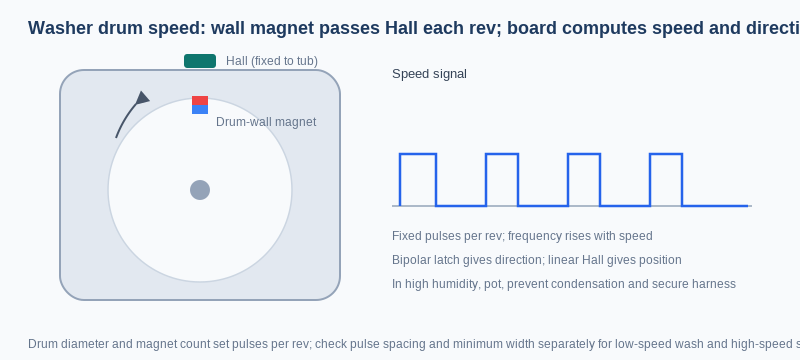
Washing-machine speed measurement commonly uses one of two layouts: magnets embedded in the inner-drum end face or outer wall with the Hall sensor fixed to the tub or motor bracket, or a multi-pole magnetic ring directly on the motor shaft giving more pulses per revolution. The first is structurally simple and suits detecting whether the drum turns and approximate speed; the second gives higher resolution for closed-loop control. The control board uses a capture input to measure pulse period and convert it to speed.
- Applicable types
- Bipolar latch, Gear-tooth sensor
- Operating temperature
- -20~85°C
- Supply voltage
- 5 V / 3.3 V
- Output
- Digital latch
- AEC-Q100
- Not required
- Operating environment
- Inside an appliance with ambient temperature and high humidity, motor vibration, possible steam and detergent contamination; 5 V/3.3 V control-board supply.
- Confirm before selection
- Motor shaft or drum; tooth count/pole pairs; air gap, magnet size and field strength; square-wave frequency or latch switch output and load resistance/capacitance; operating temperature, IP rating and harness length.
Key points
- Air-gap consistency around the drum. Drum eccentricity, bearing wear and aging suspension springs make the air gap vary periodically; magnets and Hall sensor must stay consistent around the full turn.
- Media resistance and rust. Magnets must resist water and detergent, metal parts need rust protection, and scale or corrosion also changes the magnetic field.
- Potting and mains isolation. Potting or conformal-coat thickness adds to the effective air gap; route the harness away from the drain pump, heater and motor power wiring and fix it securely.
Recommended models
FAQ
- Speed display shakes during spinning — what should I check first?
- Check drum eccentricity and aging dampers first, then whether the magnet-to-Hall air gap is even around the full turn.
- No counting at low speed — what causes it?
- Pulse spacing grows at low speed; too long a controller debounce misses counts. Calculate for the minimum speed.
- Rotation direction is misjudged — what should I do?
- A bipolar latch design must check the phase order and magnet polarity of both Hall sensors; a single Hall sensor cannot determine direction.
- Occasional missed counts — how should I troubleshoot?
- Check whether the magnet is loose, whether the pull-up and filter capacitor are suitable, and whether the harness is bundled with motor wiring.
- Speed deviates after replacing the motor or main board — what should I do?
- Verify pulses-per-revolution and magnet-count configuration, and confirm the new part's magnet layout matches the original.
Water Heater Flow & Heating SwitchImpeller flow detection and heating control for gas and electric water heaters.
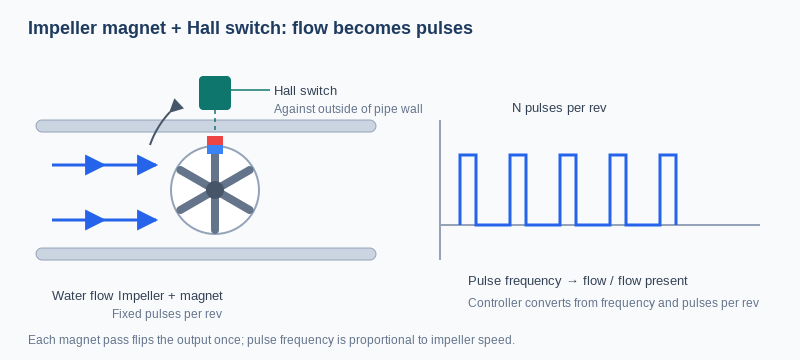
A gas water heater usually fits an impeller flow sensor at the cold-water inlet: water drives the impeller, magnets on it pass a Hall switch periodically, and the controller converts pulse frequency into flow to decide whether the minimum flow for ignition has been reached. Electric water heaters more often use a flow switch: the impeller must reach a certain speed before a valid signal is output, preventing dry heating.
- Applicable types
- Bipolar latch
- Operating temperature
- -20~85°C
- Supply voltage
- 3 V battery, or 3.3/5 V mains control board
- Output
- Digital latch
- AEC-Q100
- Not required
- Operating environment
- Gas heaters are battery-powered with condensation and vibration near the water path; electric heaters use mains with a 3.3/5 V control board; not automotive grade.
- Confirm before selection
- Battery or mains supply; maximum/minimum flow and impeller pulse frequency; magnet polarity/size and mounting air gap; pulse or switch output; temperature at the sensor mounting position.
Key points
- Flow path and impeller coaxiality. The impeller axis must follow the flow direction with room for guide flow; direct inlet impact causes runout and distorts the flow reading.
- Magnet embedding and air gap. The magnet must be securely embedded in the impeller without protruding or rubbing the pipe wall, and the chip-to-magnet gap is fixed by the structure rather than adjusted during assembly.
- Sealing and supply matching. Condensation requires cavity potting and downward-facing wire exits; check the minimum operating voltage against the instrument supply.
Recommended models
FAQ
- Low flow does not ignite or heat — what should I check first?
- Check whether the impeller is stuck by scale or debris first, then the magnet air gap and the controller minimum-flow threshold.
- Flow display fluctuates and pulses are lost — what could cause it?
- This is usually impeller bearing wear, impeller eccentricity or air bubbles in the pipe; inspect the impeller assembly and vent the inlet.
- Standby current is too high — how should I troubleshoot?
- Check whether the output pull-up still draws current in sleep, and whether the Hall output is connected to an always-on supply.
- False operation or failure after condensation — what should I do?
- Check potting, seals and wire-exit direction; condensation near the chip changes insulation.
White Goods Position & Switch DetectionPosition and switch detection in washing machines, refrigerators and other white goods.
Most position detection in white goods is a switch signal for a door, drawer, flap or knob. A magnet is fixed to the moving part and the Hall sensor is mounted in the body; the output takes one state when the magnet approaches and changes when it leaves. Compared with mechanical contacts and reed switches, a Hall sensor has no exposed contacts, does not oxidize or stick from moisture, dust or frequent operation, and is easier to seal.
- Applicable types
- Omnipolar switch, Unipolar switch
- Operating temperature
- -20~85°C
- Supply voltage
- 5 V
- Output
- Digital switch
- AEC-Q100
- Not required
- Operating environment
- Inside appliances at ambient temperature, possibly with light vibration and humidity; not automotive grade and no waterproof requirement.
- Confirm before selection
- Mounting air gap/magnet distance; magnet type (pole and field strength); 5 V or 3.3 V supply; switch output or latching state.
Key points
- Structural positioning, not visual alignment. Structural parts must define the relative position of magnet and Hall sensor; leave margin for assembly tolerance, door-seal aging and rail wear.
- Fixing and vibration. Use a small, magnetically stable magnet and a fixing method that withstands appliance vibration and drops.
- Stray fields and output matching. Motors and speakers near refrigerators and washing machines disturb the operating point; for open-collector output, confirm the pull-up and controller level.
Recommended models
FAQ
- It does not recognise the door closing — what should I check first?
- Check whether the door seal has aged or the hinge has sagged, increasing the magnet-to-Hall distance.
- It triggers without any movement — what could cause it?
- Nearby speakers, motor magnets or another magnet cause interference; adjust position or add shielding.
- Abnormal operation after a damp environment — what should I do?
- Check conformal coating and connectors; condensation causes leakage.
- Signal chatters after vibration — how should I troubleshoot?
- This is usually a loose magnet bracket or a cracked Hall solder joint; add anti-loosening and recheck solder joints.
- Trigger position differs between batches — what should I do?
- Magnet performance and assembly tolerance vary; sample-check operating distance in production.
LCD Monitor & TV Position DetectionPosition and state detection in LCD monitors and LCD televisions.
Hall sensors in LCD monitors and TVs are mainly used for panel opening, stand rotation or part-in-position detection. A magnet is embedded in the movable panel or rotating stand and a Hall switch is fixed to the main board; when the panel reaches a set angle the magnet approaches and the output changes, so the controller can switch image orientation, sleep or turn on the backlight. An omnipolar switch is insensitive to magnet polarity, so N/S orientation need not be distinguished during assembly, suiting high-volume consumer electronics.
- Applicable types
- Unipolar switch
- Operating temperature
- -20~85°C
- Supply voltage
- 5 V
- Output
- Digital switch
- AEC-Q100
- Not required
- Operating environment
- Indoor ambient temperature, no strong vibration and no water/dust requirement; powered by an adapter or main board.
- Confirm before selection
- Which position or state is detected (cover opening, rotation in position); magnet type and mounting air gap/trigger distance; 5 V or 3.3 V supply; switch, latch or analog output.
Key points
- The operating point does not provide mechanical location. Mechanical stops set the final panel position; the Hall sensor only provides a signal and must not be used for positioning.
- Air gap calculated from assembly tolerance. Panel hinge play and plastic thermal expansion change the air gap, which shifts the actuation angle.
- Avoid speakers and transformers. External fields from speaker magnets, transformers and motors can hold the switch triggered; evaluate the layout first.
Recommended models
FAQ
- The opening angle is inaccurate and the output toggles at the threshold — what should I do?
- Check magnet-to-Hall air gap and hinge play first, then whether the software uses hysteresis or a delay.
- Wrong state at high or low temperature — what should I do?
- Magnet flux and plastic brackets change with temperature; calculate the worst-case air gap and adjust the magnet if needed.
- False triggering near the speaker — what should I do?
- Adjust the Hall position or add magnetic shielding, and combine with the panel-angle signal in software.
- Standby power is high — what should I do?
- Check whether the pull-up is still powered in sleep and the Hall operating current; low-voltage standby products should use a low-power model.
- Some units do not trigger after assembly — what should I do?
- Most cases are a reversed or missing magnet or a size deviation; confirm magnet model, magnetization direction and insertion depth.
Robot Vacuum Drive, Bin & Dock DetectionDrive-wheel speed, dust-bin/water-tank seating and charging-dock detection for robot vacuums.
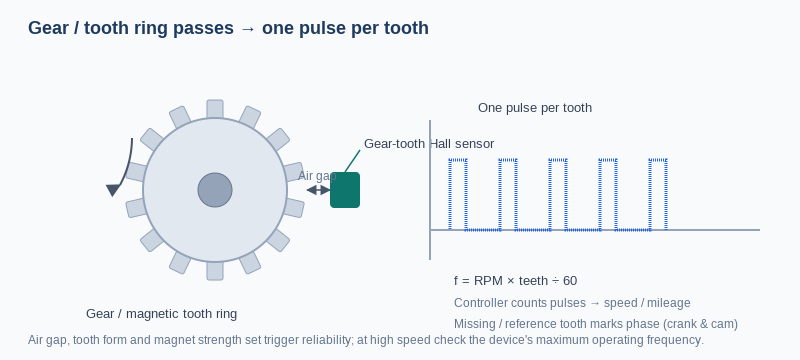
A robot vacuum usually has three Hall detection functions: drive-wheel speed, dust-bin/water-tank seating and charging-dock docking. Wheel speed uses a multi-pole magnetic ring or gear ring on the wheel axle or gearbox output with a bipolar latch Hall sensor producing clean pulses for odometry, speed and differential steering. The dust bin and water tank use an omnipolar switch to detect whether a magnet is seated. For docking, a magnet on the charging dock approaches a sensor on the robot to confirm that it is properly seated.
- Applicable types
- Bipolar latch, Omnipolar switch
- Operating temperature
- -10~70°C
- Supply voltage
- 3.3 V
- Output
- Digital switch, Digital latch
- AEC-Q100
- Not required
- Operating environment
- Indoor floors with dust, hair, collisions and frequent starts/stops; battery-powered and compact.
- Confirm before selection
- Drive-wheel speed method and pulses per revolution; dust-bin/water-tank seating structure; docking method; battery voltage and sleep current requirement; daily operating time.
Key points
- Wheel-ring concentricity and cleaning. The ring must be coaxial with the axle with an even air gap, and the structure needs a cleaning path so hair wrapping cannot make the ring eccentric and drop pulses.
- Bin magnet fixing and air gap. The magnet should be fixed near the latch and must not shift from drops or repeated removal; size the magnet for the maximum assembly gap so the omnipolar switch still triggers.
- Dock decision and sleep power. Do not declare docked from one Hall sensor alone; combine left/right sensors, infrared docking signals or charging current, and account for pull-up and sensor sleep current on battery.
Recommended models
FAQ
- Mileage drifts and the robot veers — what should I check first?
- Check whether the wheel ring is wrapped in hair and the air gap is even, then verify pulses per revolution and firmware parameters.
- Missed pulses at low speed or spinning in place — what causes it?
- Usually too few poles or too large an air gap makes pulse spacing long and the controller misses counts; check pole pairs, air gap and the firmware minimum frequency.
- Docking keeps failing and the robot readjusts — what should I do?
- Confirm dock magnet position and sensor layout, check furniture or metal interference, and use multiple signals in firmware.
- The bin/tank is falsely reported missing — how should I troubleshoot?
- Check whether the magnet has detached, the latch is deformed, or the air gap increased after a drop; verify magnet model and magnetization direction.
- Shorter standby time — is it Hall-related?
- Check whether the pull-up and sensor supply remain active in sleep; switch to intermittent sampling or a low-power model.
Door/Window Magnetic Contact & AlarmDoor/window open-close, intrusion alarm and smart-lock magnetic position detection.
A door/window magnetic alarm commonly mounts the magnet on the door or window leaf and the Hall sensor on the frame, facing each other when closed. Opening the door or window moves the magnet away, the Hall output changes and the wireless alarm is triggered. Compared with a reed-switch design, the Hall sensor has no glass tube or mechanical contact, and its drop and vibration robustness differs by structure; final behaviour still needs validation against the complete product and actual vibration conditions.
- Applicable types
- Omnipolar switch
- Operating temperature
- -20~85°C
- Supply voltage
- 3 V battery
- Output
- Digital switch
- AEC-Q100
- Not required
- Operating environment
- Door/window frames with temperature difference, humidity, dust and switching vibration; battery-powered with several years of target life.
- Confirm before selection
- Battery type and target life; maximum door/window gap and required actuation distance; tamper and magnetic-interference resistance; alarm-panel input type; mounting method (screw or adhesive).
Key points
- Alignment and actuation distance. The actuation distance must account for magnet size, frame/leaf gap and mounting deviation; it must not sit at the threshold.
- Magnetic path. Steel doors/windows, security grilles and metal frames divert the field; adjust position or magnet strength.
- Low power. Battery-powered devices must account for standby current; sampling period and wake method directly affect service life.
Recommended models
FAQ
- It still reports open after closing — what should I check first?
- Check whether magnet and Hall sensor are aligned and whether the air gap exceeds the actuation distance, then whether the door/window is deformed or sagging.
- Frequent unexplained alarms — what should I do?
- Check nearby ferrous structures and other magnetic sources, and whether leaf movement makes the magnet oscillate at the operating point.
- The battery drains too fast — what causes it?
- Check sleep current and sampling duty cycle, and whether the device returns to low power promptly after an alarm.
- Performance is worse on metal doors/windows — what should I do?
- Metal frames divert the field; adjust the mounting position or use a stronger magnet, then revalidate the actuation distance.
- False alarms after a drop or battery replacement — how should I troubleshoot?
- Check whether the magnet has shifted, solder joints are loose, and whether power-up initialization needs to recalibrate the state.
Typical Cases (2)
Hall Sensors in Massage Chairs
Unipolar, latch and omnipolar Hall sensors control the travel and speed of massage-chair mechanisms.
View Case →Smart Range Hood Lift Panel Limit
Hall sensors at the top and bottom of the smoke-deflector rail cut motor power at the end positions to prevent overload and stall.
View Case →Project case references
Compiled from real application projects; confirm parameters against your structure and operating conditions.
Motorized smart curtain track limit
A magnet on the curtain slider reaches limit Hall sensors at both ends of the track; the controller memorises travel and cuts power.
Appliance Control Panel & Textile Machinery
Washing machine load weighing & vibration detection
A magnet on the tub moving closer to a linear Hall sensor estimates load weight, while off-balance movement during spinning is detected in real time.
Washing Machine Speed & Position
Smart appliance & toilet-seat position limits
Hall sensors at the start and end of a track for the toilet sprayer or dishwasher spray arm cut the motor when the end position is reached, preventing stall.
White Goods Position & Switch Detection
Smart toilet sprayer extension limit
An origin Hall sensor detects full retraction after cleaning and cuts the motor, preventing the sprayer from being stepped on and broken.
White Goods Position & Switch Detection
Robot vacuum water-tank and dust-bin seating detection
Magnets in the tank and bin trigger Hall sensors; the robot may start only when seated and stops with a reminder if not.
Robot Vacuum Drive, Bin & Dock Detection
Wireless door/window intrusion alarm
A split-type door sensor: when the door is forced open the Hall sensor changes state, wakes the wireless chip and raises an alarm.
Door/Window Magnetic Contact & Alarm
This page introduces common practices for this application and Ouzhuo's available models for preliminary evaluation. For final selection, share your structure, air gap and operating conditions with our engineers, who will help verify the parameters and provide samples and basic application guidance.